D-SHIELD
Digital Twin-Based Stampede Hazard Identification, Estimation & Live Detection





Final Year Project — PES Modern College of Engineering, Pune
Research paper in progress.
Overview
D-SHIELD is a real-time crowd safety platform that uses digital twin technology to monitor, model, and predict stampede risk in dense public spaces — before an incident occurs.
The system creates a live virtual replica of a physical crowd environment, continuously updated from edge sensor data. Risk is assessed autonomously across spatial zones, enabling early warning and intervention without requiring human operators to watch camera feeds.
Problem Statement
Crowd crushes and stampedes remain a leading cause of mass-casualty events globally. Existing solutions are either reactive (post-incident CCTV review) or require expensive dedicated infrastructure. D-SHIELD addresses this with a low-cost, deployable, real-time system built on commodity edge hardware.
System Overview
D-SHIELD operates as a three-layer architecture:
Edge Layer        →    Transport Layer    →    Intelligence Layer
Raspberry Pi           MQTT (Mosquitto)        Digital twin engine
Camera feed            Low-latency stream       Risk assessment
Sensor data            Pub/sub model            Zone management
                                                Alert generation
Edge — Deployed on Raspberry Pi, handles real-time video ingestion and local inference. Designed to operate under constrained compute with frame-loss tolerance and stable identity tracking through occlusion and camera jitter.
Transport — MQTT-based pub/sub pipeline streams processed signals from edge to cloud continuously, decoupling ingestion from analysis.
Intelligence — A digital twin models the crowd environment as a spatial graph of zones. Risk propagates across connected zones based on density and behavioral signals. Alerts are generated before thresholds are breached.
Key Capabilities
- Real-time person detection — identifies and tracks individuals across camera frames with stable IDs through occlusion
- Fall event detection — distinguishes fallen persons from normal crowd movement
- Multi-zone risk propagation — risk in one zone automatically influences adjacent zones
- Digital twin synchronization — virtual model stays live-synced with physical crowd state
- Dual-mode operation — live camera feed mode and simulation mode for testing
- Hybrid storage — time-series crowd analytics and structured event data stored separately
Experimental Results
Evaluated over 31 runs across varied crowd density conditions:
| Metric | Result |
|---|---|
| Overall accuracy | 79.3% |
| Spatial consistency | 1.000 |
| Fall detection F1 (Class 2) | 0.65 |
Spatial consistency of 1.000 indicates the zone-level risk model remained stable across all test scenarios — no false zone transitions were observed.
Tech Stack
| Layer | Technology |
|---|---|
| Edge compute | Raspberry Pi, Python |
| Computer vision | MediaPipe, YOLOv8, ResNet |
| Edge-to-cloud transport | MQTT (Mosquitto) |
| Backend | Node.js |
| Time-series storage | InfluxDB |
| Structured storage | Amazon RDS |
| Frontend | JavaScript |
Demo
Real-Time Camera Mode Live camera feed ingestion on Raspberry Pi — frame processing, person detection, and real-time risk assessment through the decision engine.
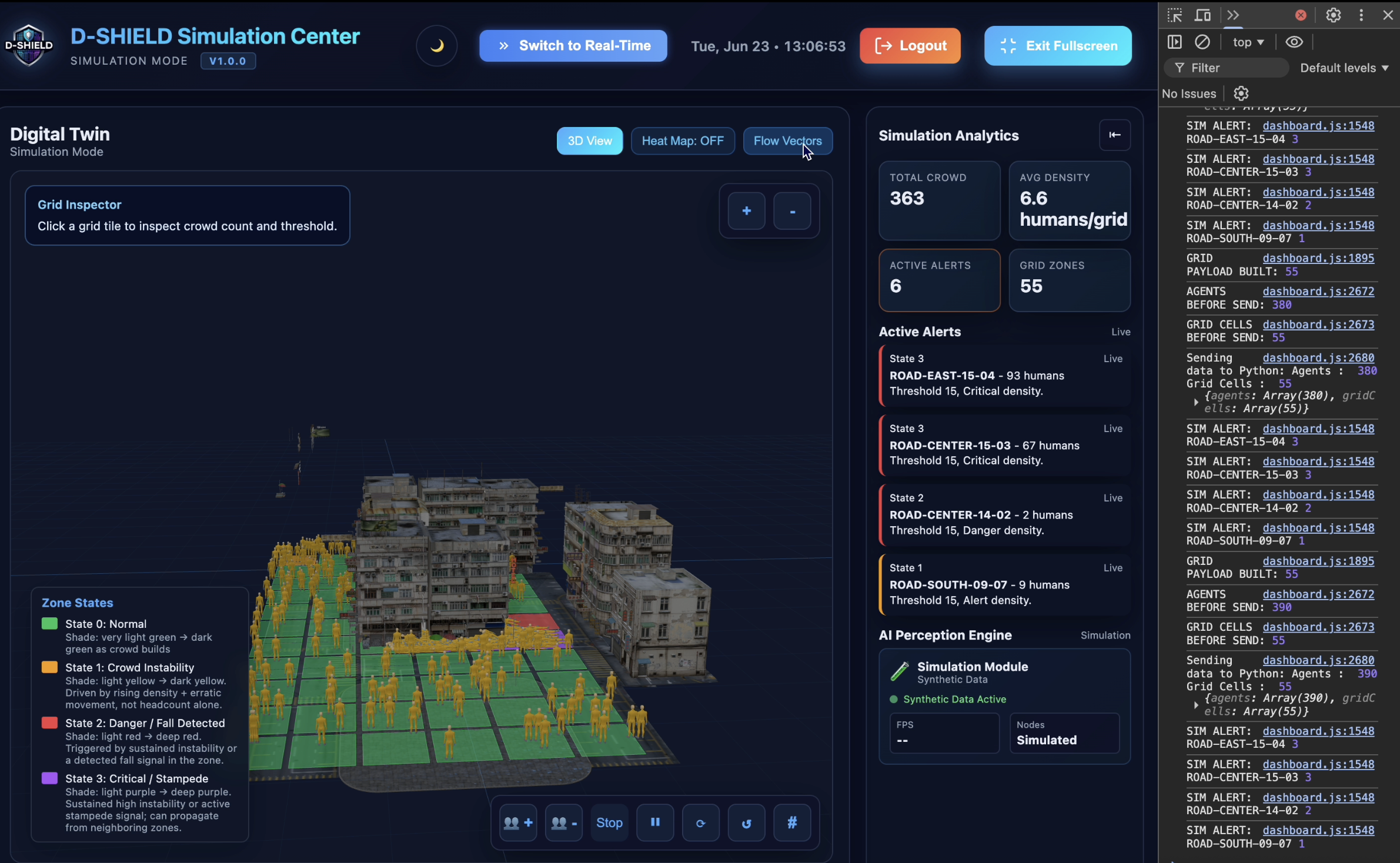
Simulation Mode Synthetic crowd agents generated and tracked across a grid-based digital twin. Demonstrates zone-level risk propagation and alert generation without a physical camera feed.
Demo videos available on the YouTube and LinkedIn LinkedIn project page.
Research
This project is associated with an ongoing research paper. Model architecture specifics, risk propagation logic, detection thresholds, and training methodology are reserved for the paper submission.
Associated with: Progressive Education Society's Modern College of Engineering, Pune Duration: Oct 2025 – Jun 2026 Type: Final Year Project (BE Information Technology)
Repository Notice
This is a public-facing overview repository. The core detection pipeline, risk propagation algorithm, model weights, and training data are not published here as they are part of an active research submission.
For collaboration or research inquiries, reach out via LinkedIn.
Research-protected. Code and methodology may not be reproduced without explicit permission from the authors.