CloudTwin








Overview
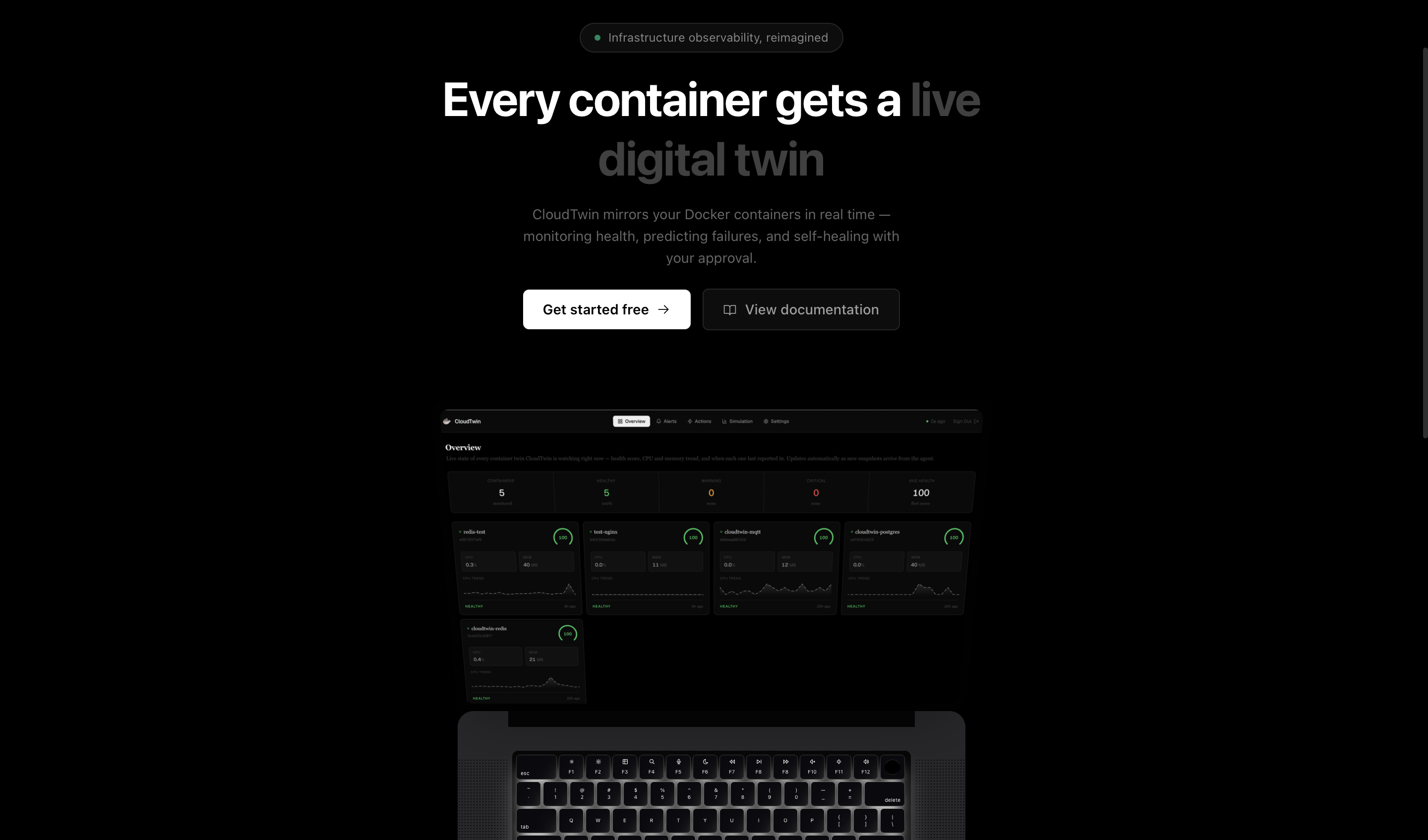
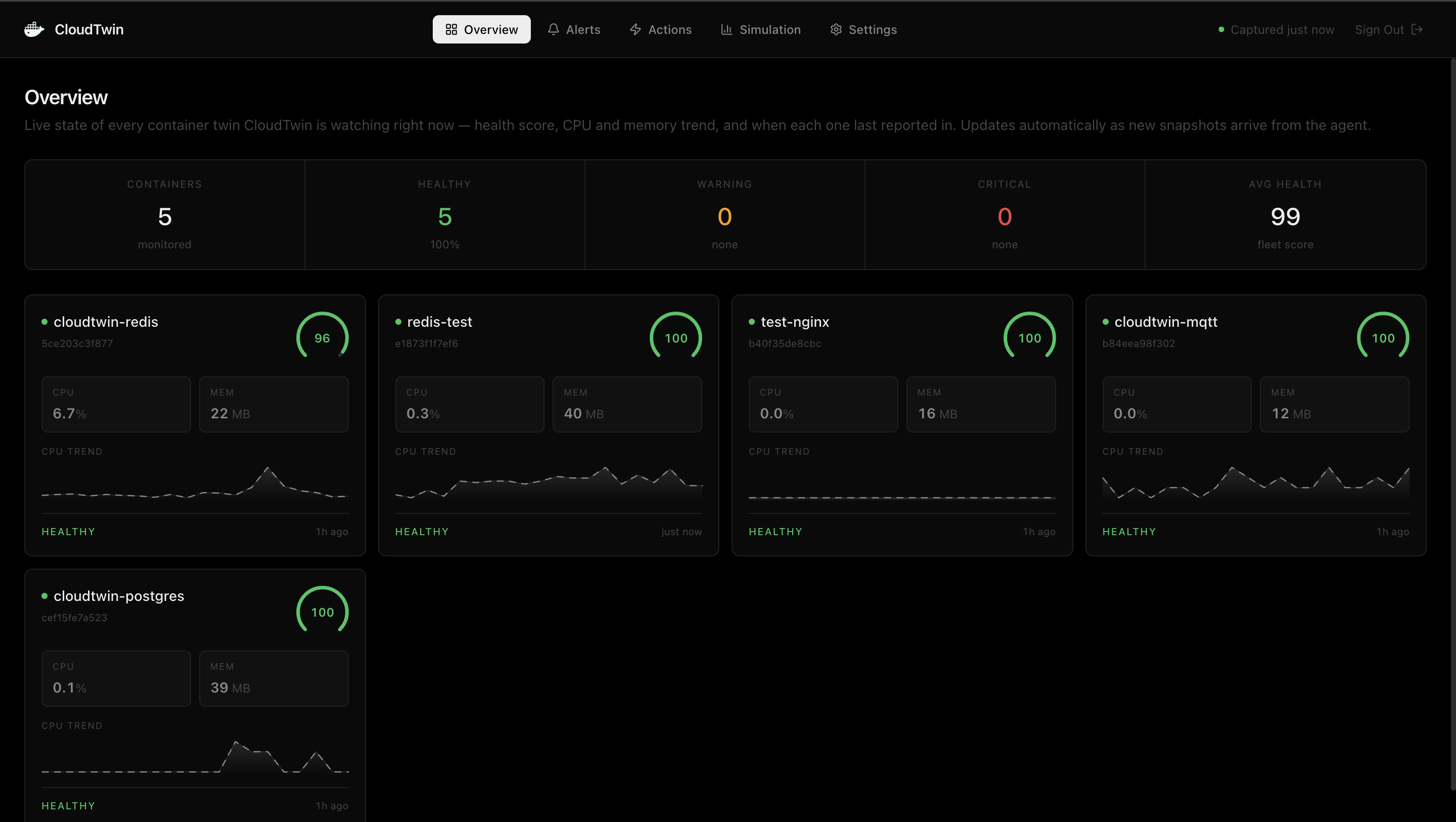
CloudTwin creates a live virtual counterpart — a digital twin — for every Docker container running on a monitored host. Each twin continuously mirrors its container's real-time state, computes a health score, predicts failure risk, and can autonomously propose and execute self-healing actions through a human-in-the-loop approval workflow.
Most observability tools stop at Monitor → Alert. CloudTwin implements a full closed loop:
Monitor → Predict → Decide → Act → Confirm
| Problem | CloudTwin's Solution |
|---|---|
| Reactive alerting | Rules engine evaluates sustained thresholds, creates alerts before users notice |
| Manual remediation | Decision engine proposes restarts; agent executes on human approval |
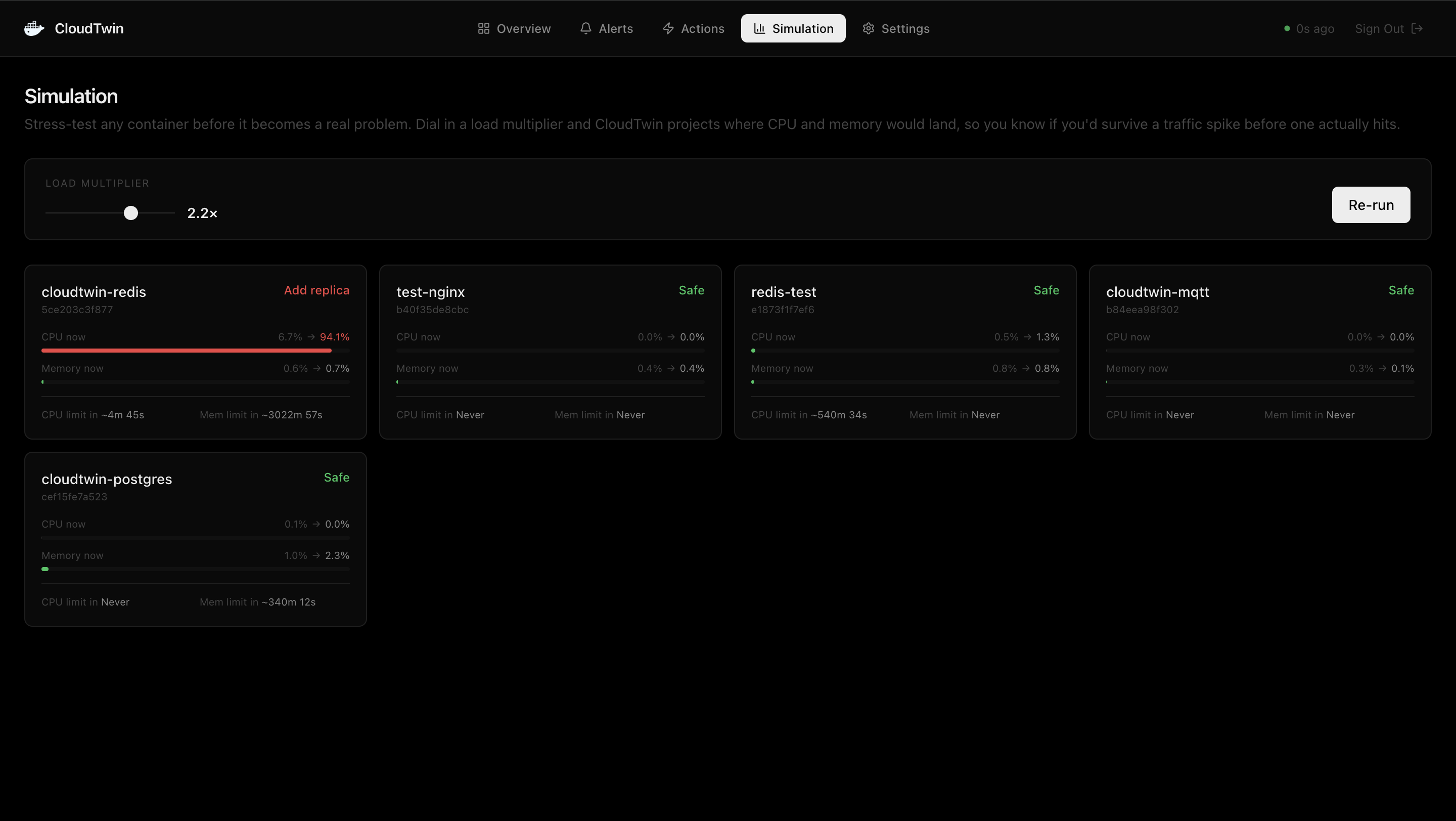
| No trend awareness | What-if simulator projects metrics at increased load using historical slope |
| Opaque infrastructure | Health score (0–100) synthesises CPU + memory into a single readable signal |
| No accountability | Every alert, action, and ack recorded with full lifecycle timestamps |
| Tight coupling | Agent-pull pattern — backend never needs network access to target host |
| Multi-user chaos | Workspace isolation — every user sees only their own containers |
Screenshots
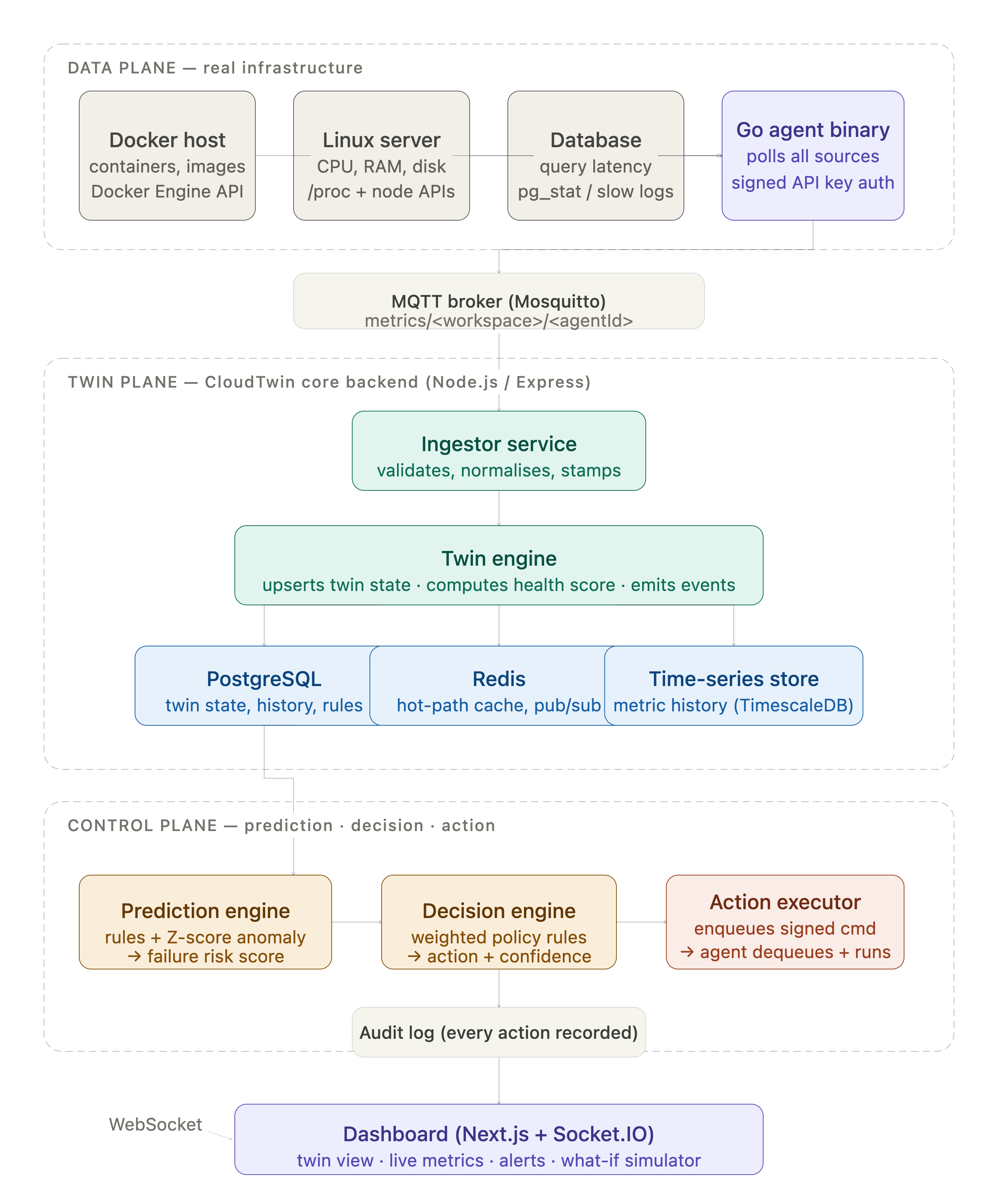
System Architecture
Dashboard Overview
What-if Simulation
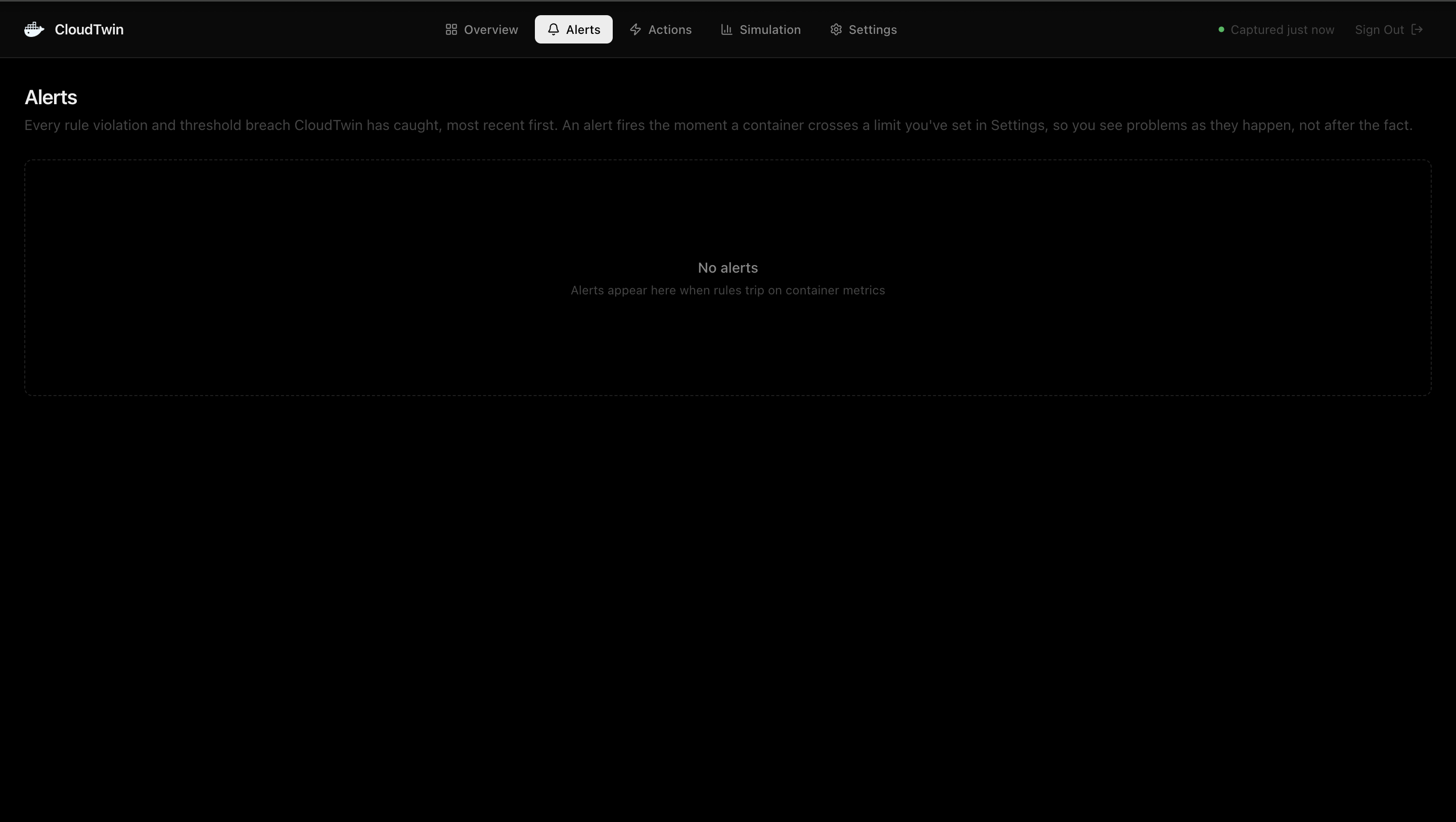
Alerts Feed
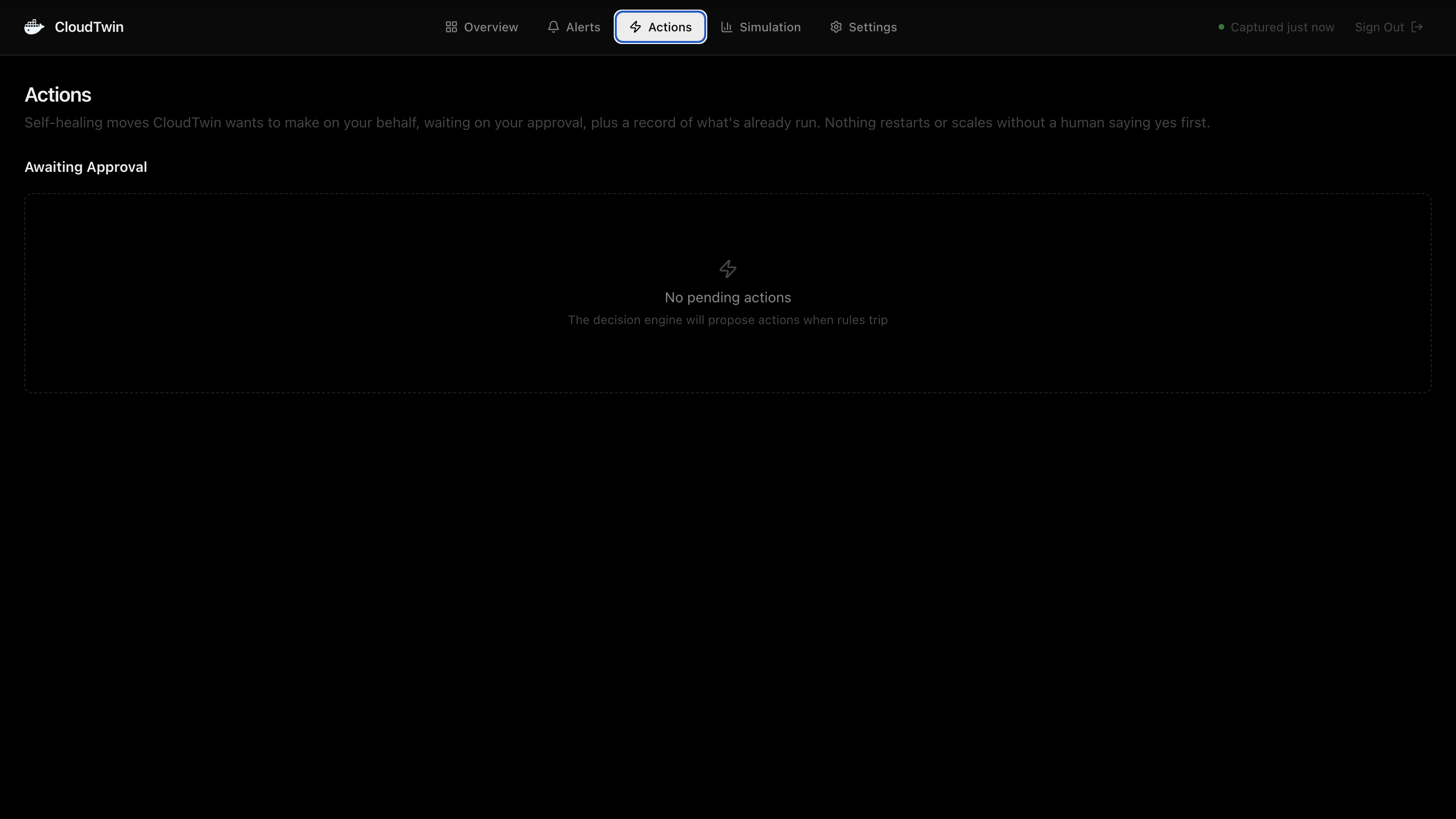
Actions Panel
Login
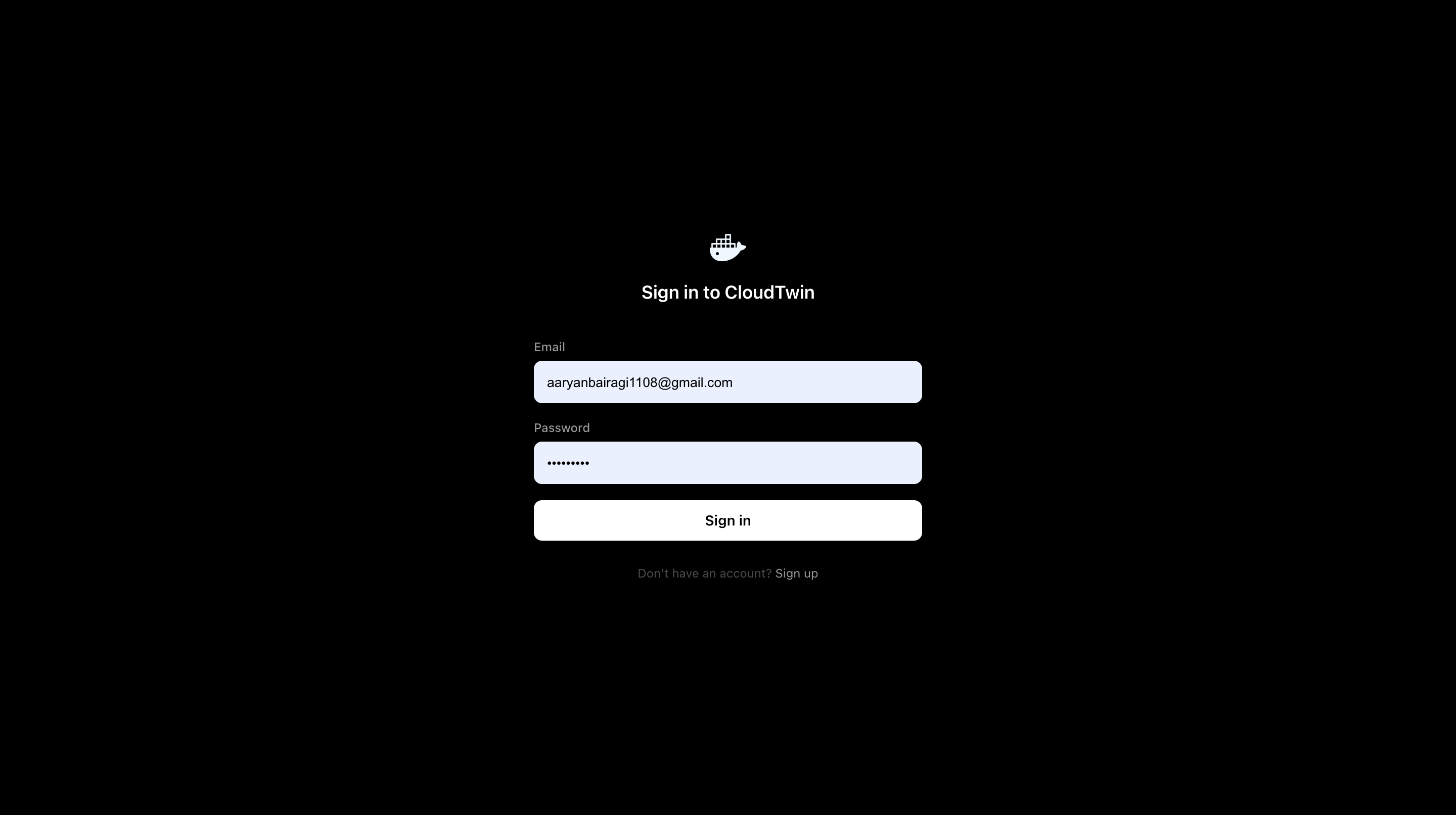
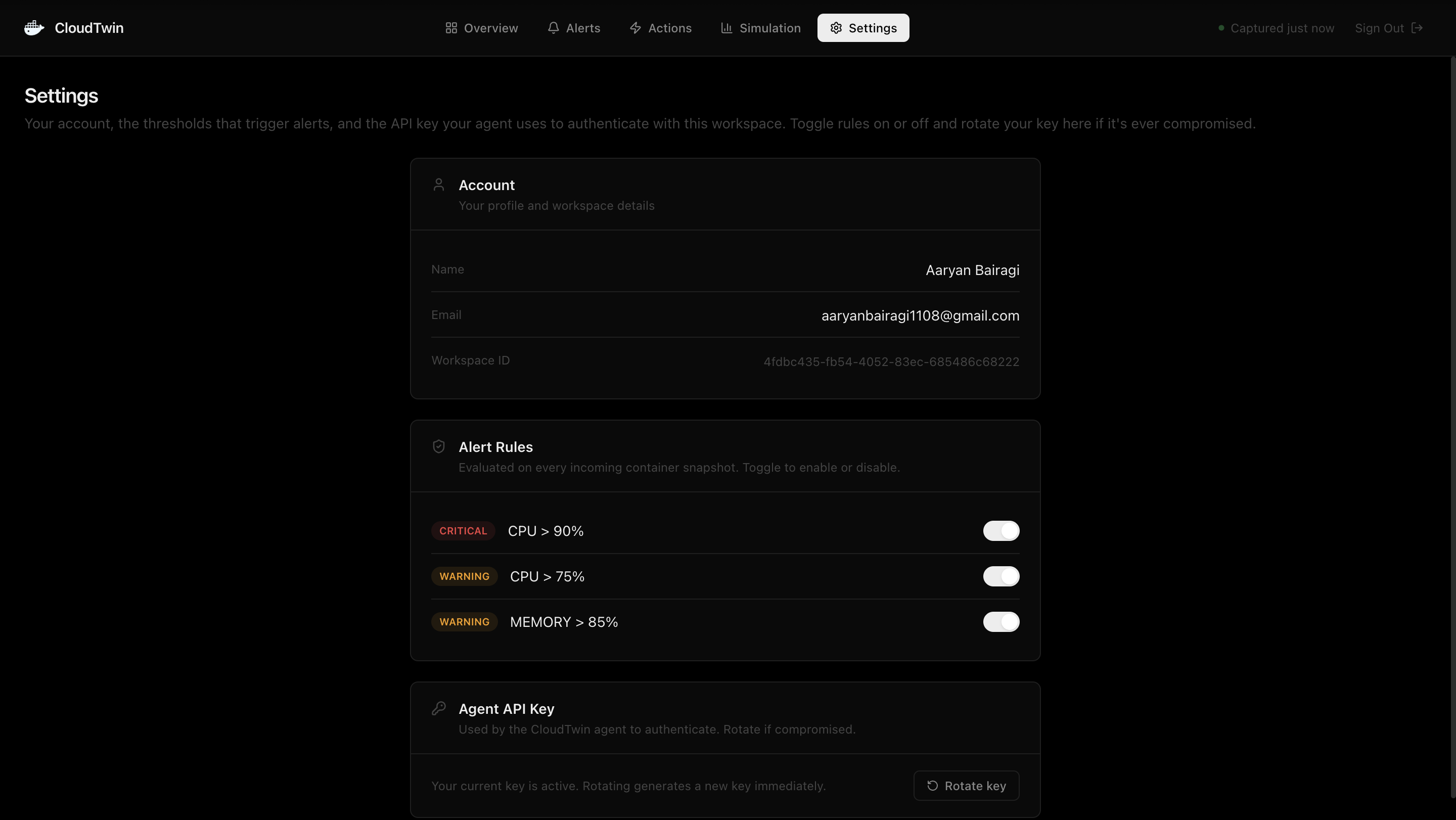
Settings
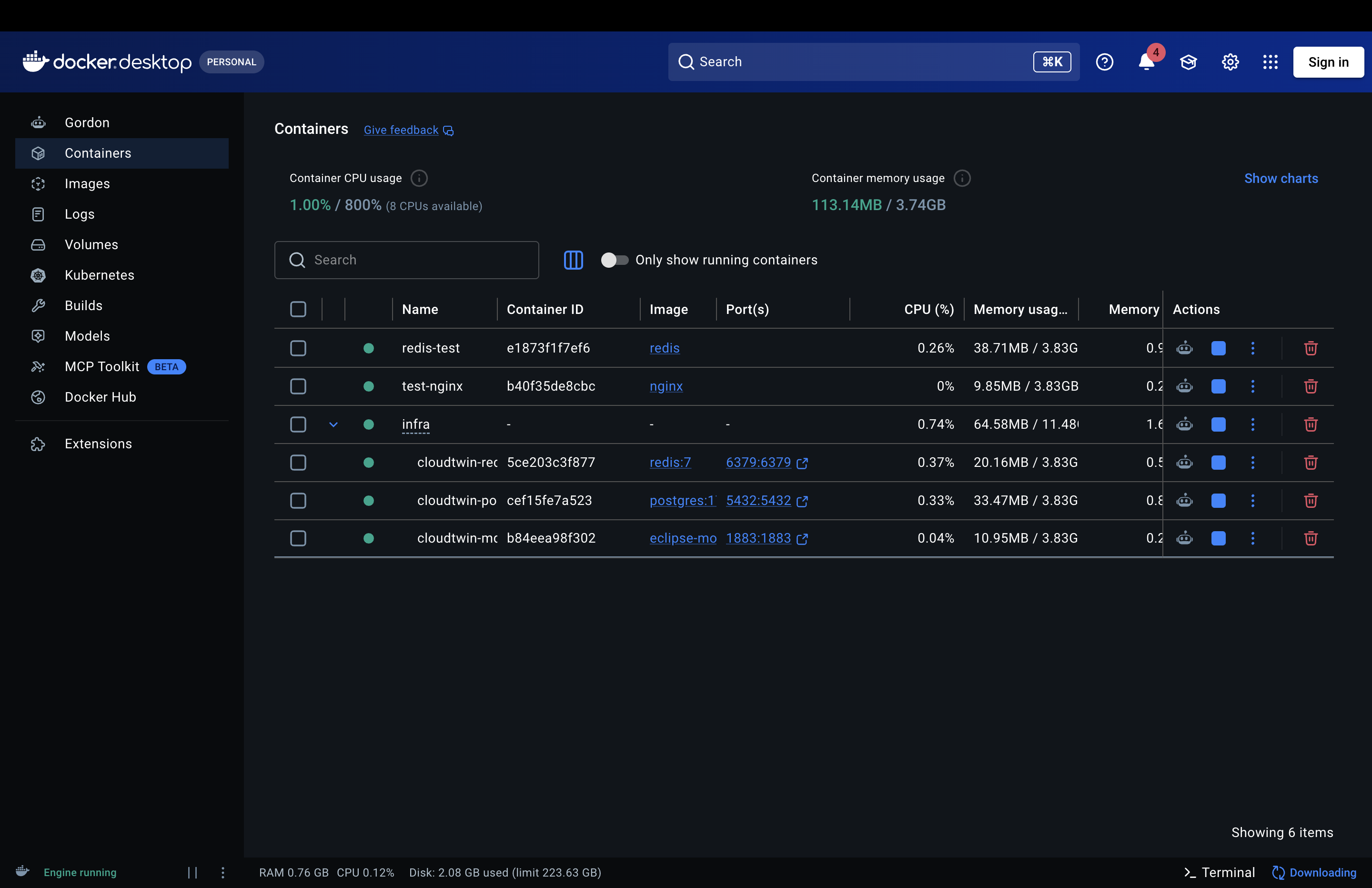
Live Docker Containers (Agent monitoring)
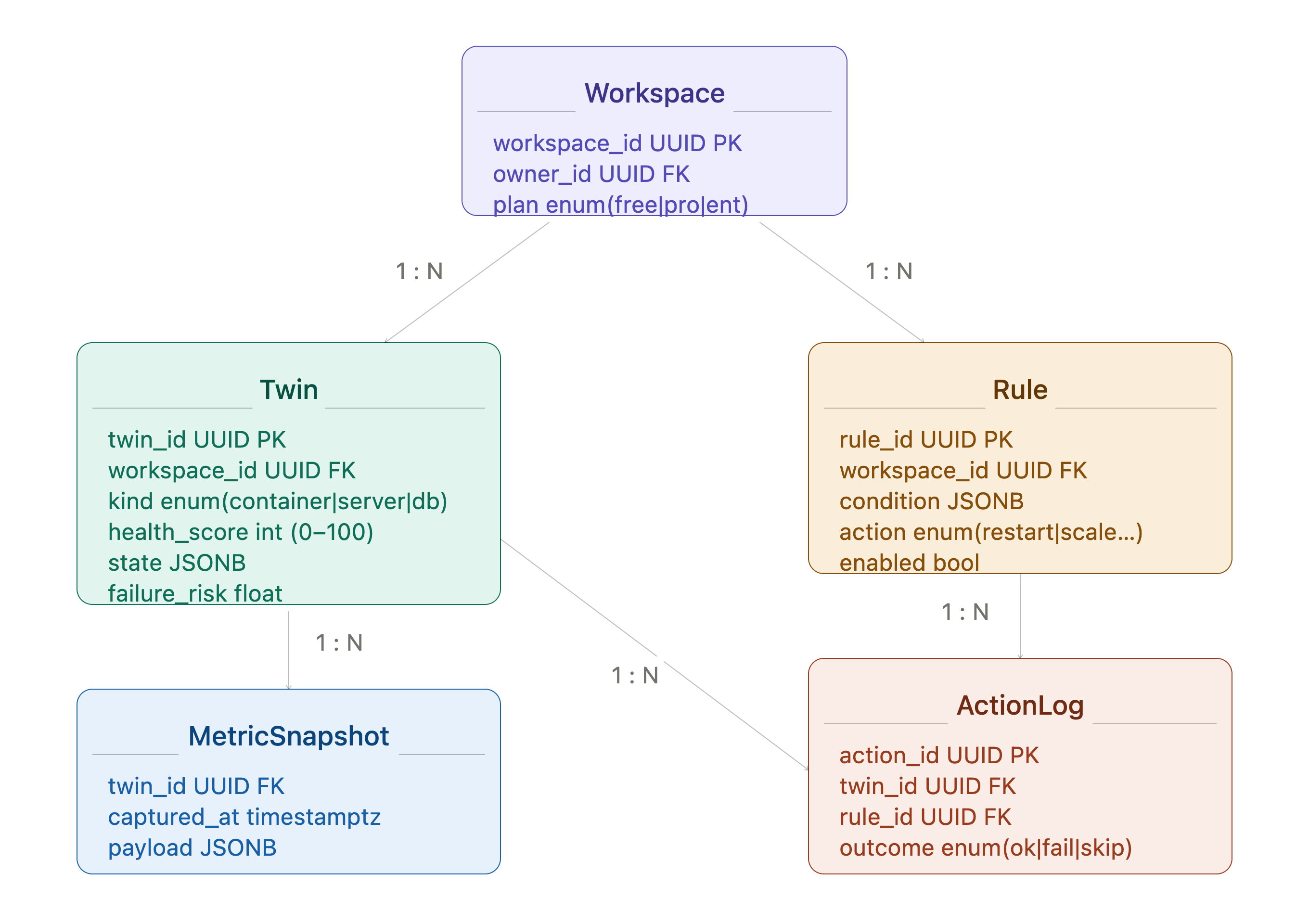
Data Model
Architecture
The system is structured across three independent planes:
Agent plane — A compiled Go binary runs on the monitored host. It polls the local Docker Engine API via Unix socket every 10 seconds, builds metric snapshots, and POSTs them directly to the backend over HTTPS using an API key. A second goroutine polls the backend for approved commands and executes them locally via Docker — the backend never connects to the host directly.
Backend plane — A Node.js/Express server receives snapshots via POST /api/snapshots, runs each through the twin engine (health score computation, Postgres upsert), evaluates workspace-scoped rules, creates alerts, and proposes restart actions. All data is isolated by workspace ID derived from the agent's API key.
Control plane — A human approves or rejects proposed actions on the dashboard. Approved actions push to a per-workspace Redis queue. The agent polls, claims, and executes them, then acks the result. Every transition from pending → approved → executing → completed (or failed) is permanently recorded.
Key Design Decisions
HTTP-only agent — no MQTT required
The agent publishes snapshots directly to POST /api/snapshots over HTTPS. Users need only 3 environment variables — no MQTT broker URL, no shared credentials, no broker setup. This is how Datadog, Grafana Agent, and New Relic all work: the agent calls home to your API, internal routing is your concern.
# All a user needs to run the agent
export CLOUDTWIN_BACKEND_URL=https://cloudtwin.onrender.com
export CLOUDTWIN_API_KEY=ct_xxx
export CLOUDTWIN_WORKSPACE_ID=xxx
./cloudtwin-agent
Agent-pull command execution
The backend never SSHes or connects directly to a monitored host. Approved commands push to a Redis list keyed commands:<workspaceId>:<twinId>. The agent polls /commands/claim, pops the command, runs it locally via Docker socket, and acks the result. This is the same pattern used by Ansible, Teleport, and AWS SSM.
Workspace isolation
Every API key is scoped to a workspace. Every database query filters by workspace_id derived from the API key. Two users' containers never mix, and one user cannot access another's data even with knowledge of a twin ID.
Health score model
score = 100 - (cpu_percent × 0.5) - (memory_percent × 0.3)

≥ 80  →  healthy
≥ 50  →  warning
< 50  →  critical
What-if simulation
slope     = (latest_value - oldest_value) / elapsed_seconds
projected = current × multiplier + slope × 300s

ADD_REPLICA      projected CPU ≥ 90% or memory ≥ 88%
MONITOR_CLOSELY  projected CPU ≥ 70% or memory ≥ 75%
SAFE             otherwise
Decision engine cooldown
Before proposing a restart, the engine checks for any non-terminal action on the same twin within the last 10 minutes. A flapping container won't flood the actions queue with duplicate proposals.
Tech Stack
Agent
| Technology | Purpose |
|---|---|
| Go 1.24 | Compiled binary, two independent goroutines (metrics + commands) |
| Docker Engine API (Unix socket) | Container enumeration, stats streaming, docker restart |
| Net/HTTP (stdlib) | Snapshot publishing + command polling over HTTPS |
Backend
| Technology | Version | Purpose |
|---|---|---|
| Node.js + Express | 4.x | REST API, snapshot ingestion, request routing |
bcryptjs | 2.4 | Password hashing |
jsonwebtoken | 9.0 | JWT auth for dashboard sessions |
express-validator | 7.2 | Input validation on all auth routes |
express-rate-limit | 7.4 | 300 req/min global, 20 req/15min on auth |
pg (node-postgres) | 8.13 | PostgreSQL connection pool with SSL |
redis | 4.7 | Per-workspace per-twin command queues |
Frontend
| Technology | Version | Purpose |
|---|---|---|
| Next.js | 16.2 | React framework, App Router |
| React | 19.2 | UI rendering |
| TypeScript | 5 | Type-safe API contracts |
| Tailwind CSS | 4 | Monochrome dark theme |
| Recharts | 3.9 | Live CPU sparklines per twin card |
| Lucide React | 0.383 | Icon system |
| Framer Motion | — | MacBook scroll animation on landing page |
Infrastructure (Production)
| Service | Provider | Purpose |
|---|---|---|
| Backend | Render (free) | Node.js web service |
| PostgreSQL | Render (free) | Primary database |
| Redis | Render (free) | Command queue |
| Frontend | Vercel (free) | Next.js hosting |
Data Model
users
├── id            UUID PK
├── email         TEXT UNIQUE
├── password_hash TEXT          bcrypt, never stored raw
└── name          TEXT

workspaces
├── id            UUID PK
└── owner_id      UUID FK → users

api_keys
├── id            UUID PK
├── workspace_id  UUID FK → workspaces
├── key_hash      TEXT UNIQUE   SHA-256, never stored raw
└── last_used_at  TIMESTAMPTZ

twins
├── twin_id       TEXT
├── workspace_id  UUID FK → workspaces
├── name          TEXT
├── status        TEXT          healthy | warning | critical | unknown
├── health_score  INTEGER       0–100
├── state         JSONB         latest raw snapshot
└── PRIMARY KEY (twin_id, workspace_id)

metric_snapshots
├── twin_id       TEXT
├── workspace_id  UUID
├── captured_at   TIMESTAMPTZ
├── cpu_percent   DOUBLE
├── memory_percent DOUBLE
├── memory_mb     DOUBLE
└── payload       JSONB

rules
├── workspace_id  UUID FK → workspaces
├── metric        TEXT          cpu | memory
├── operator      TEXT          > | >= | < | <=
├── threshold     DOUBLE
└── severity      TEXT          warning | critical

alerts
├── workspace_id  UUID
├── twin_id       TEXT
├── rule_id       INTEGER FK → rules
└── metric, current_value, threshold, severity, message

actions
├── workspace_id  UUID
├── twin_id       TEXT
├── action_type   TEXT          restart
├── status        TEXT          pending → approved → executing → completed | failed | rejected
└── approved_at, executed_at, completed_at TIMESTAMPTZ
Closed-Loop Flow
1. Agent POSTs snapshot         POST /api/snapshots  { containerId, cpuPercent: 95, ... }
        │  X-API-Key: ct_xxx
        ▼
2. Backend derives workspace    API key → workspace_id
        │
        ▼
3. Twin engine                  upsertTwin → health_score = 2, status = critical
        │
        ▼
4. Rules engine                 cpu > 90 matched → createAlert
        │
        ▼
5. Decision engine              cooldown clear → INSERT actions (status: pending)
        │
        ▼
6. Dashboard ActionsPanel       human sees RESTART proposed for <container>
        │
   ┌────┴────┐
Approve    Reject
   │
   ▼
7. POST /actions/:id/approve    RPUSH commands:<workspaceId>:<twinId>
        │
        ▼
8. Agent command loop           GET /commands/claim → pops command → status: executing
        │
        ▼
9. docker restart               Docker Engine API: POST /containers/:id/restart
        │
        ▼
10. POST /commands/:id/ack      { success: true } → status: completed
API Reference
Auth
| Method | Endpoint | Auth | Description |
|---|---|---|---|
POST | /auth/signup | — | Create account — returns token + agentApiKey (once) |
POST | /auth/login | — | Sign in — returns JWT |
GET | /auth/me | JWT | Current user + workspace ID |
POST | /auth/api-key/rotate | JWT | Rotate agent API key |
Twins
| Method | Endpoint | Auth | Description |
|---|---|---|---|
GET | /twins | JWT | All twins in workspace |
GET | /twins/:id | JWT | Single twin detail |
GET | /twins/:id/history | JWT | Metric history (last 100) |
Alerts & Actions
| Method | Endpoint | Auth | Description |
|---|---|---|---|
GET | /alerts | JWT | All alerts, most recent first |
GET | /actions | JWT | All actions in workspace |
POST | /actions/:id/approve | JWT | Approve — pushes to Redis queue |
POST | /actions/:id/reject | JWT | Reject — terminal state |
Agent (API key auth)
| Method | Endpoint | Auth | Description |
|---|---|---|---|
POST | /api/snapshots | API Key | Ingest container metrics snapshot |
GET | /commands/claim | API Key | Pop next approved command |
POST | /commands/:id/ack | API Key | Report execution result |
Simulation & Settings
| Method | Endpoint | Auth | Description |
|---|---|---|---|
GET | /simulate/:twinId?loadMultiplier=2 | JWT | Project metrics at load multiple |
GET | /settings/rules | JWT | List workspace alert rules |
PATCH | /settings/rules/:id | JWT | Toggle rule enabled/disabled |
Running Locally
Prerequisites
- Docker + Docker Compose
- Go 1.21+
- Node.js 18+
1. Start infrastructure
cd infra

# Create MQTT password file (Mosquitto, for local infra only)
docker run --rm -v $(pwd):/output eclipse-mosquitto:2 \
  mosquitto_passwd -c -b /output/mosquitto.passwd cloudtwin cloudtwin

docker compose up -d
# Starts: PostgreSQL (5432), Redis (6379)
2. Backend
cd backend
cp .env.example .env       # fill in your values
npm install
node src/db/init.js        # creates tables + seeds 3 default rules
npm start                  # listens on :4000
3. Frontend
cd frontend
echo "NEXT_PUBLIC_API_BASE=http://localhost:4000" > .env.local
npm install
npm run dev                # listens on :3000
4. Sign up + run the agent
- Open
http://localhost:3000→ Sign up - Copy your API key and workspace ID from the onboarding page
- Run the agent:
cd agent
export CLOUDTWIN_BACKEND_URL=http://localhost:4000
export CLOUDTWIN_API_KEY=ct_your_key_here
export CLOUDTWIN_WORKSPACE_ID=your_workspace_id
go run main.go
Your Docker containers appear in the dashboard within 10 seconds.
Environment variables
backend/.env
PGHOST=localhost
PGPORT=5432
PGUSER=cloudtwin
PGPASSWORD=cloudtwin
PGDATABASE=cloudtwin
REDIS_URL=redis://localhost:6379
JWT_SECRET=generate-with-node-crypto-randomBytes-64-hex
CORS_ORIGIN=http://localhost:3000
frontend/.env.local
NEXT_PUBLIC_API_BASE=http://localhost:4000
Production Deployment
| Service | Platform | Notes |
|---|---|---|
| Backend | Render Web Service | Auto-deploys from main |
| PostgreSQL | Render Postgres | Free tier — export before 90-day limit |
| Redis | Render Redis | Free tier — no persistence |
| Frontend | Vercel | Auto-deploys from main, always-on |
Deploy your own
- Fork this repo
- Create Render Postgres + Redis in Singapore region
- Create Render Web Service → root directory
backend→ runtime Node → add all env vars - Run
node src/db/init.jsfrom Render Shell to apply schema - Import repo to Vercel → root directory
frontend→ addNEXT_PUBLIC_API_BASE - Update
CORS_ORIGINin Render env to your Vercel URL
Current Status
| Feature | Status |
|---|---|
| Docker Engine API metric collection | ✅ |
| HTTP snapshot ingestion (no MQTT for users) | ✅ |
| JWT auth + API key auth | ✅ |
| Workspace isolation (multi-user) | ✅ |
| Twin engine with health score | ✅ |
| Rules-based alert engine | ✅ |
| Decision engine with cooldown | ✅ |
| Redis command queue (workspace-scoped) | ✅ |
| Agent-pull self-healing execution | ✅ |
| Full action lifecycle audit trail | ✅ |
| What-if load simulation | ✅ |
| Input validation + rate limiting | ✅ |
| Jest test suite (9 tests) | ✅ |
| GitHub Actions CI | ✅ |
| Render + Vercel deployment | ✅ |
| WebSocket live push | ❌ Polling every 5s |
| Kubernetes agent | ❌ Planned |
| ML anomaly detection | ❌ Planned |
Planned Extensions
- Kubernetes agent — watch Pod resources via K8s API,
kubectl rollout restartas the action type - ML anomaly detection — Isolation Forest per twin, replaces fixed thresholds with learned baselines
- WebSocket live push — Redis pub/sub → broadcaster, eliminates 5s polling lag
- Scale-replica action —
docker compose up --scalealongside restart
License
MIT — see LICENSE.